Evidence review · Protein targets
How Much Protein Do You Actually Need?
Protein needs change with age, training, illness, and kidney health. Use evidence-based ranges without treating an athletic target as a rule for everyone.
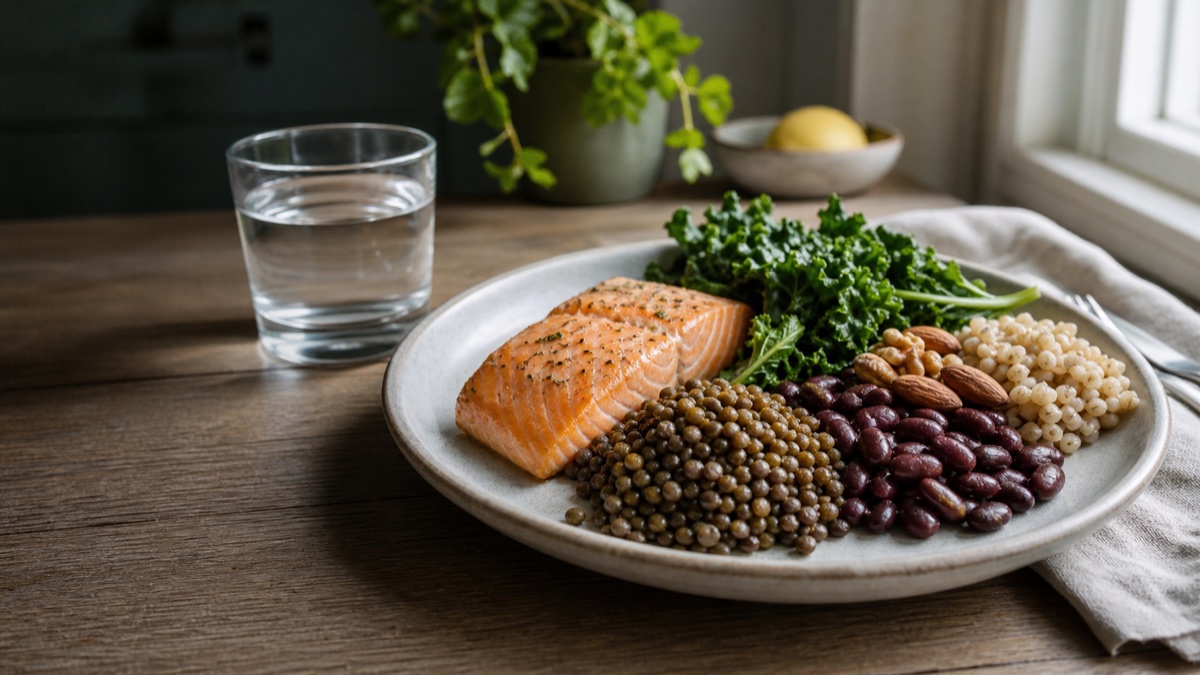
Protein is essential for muscle, organs, enzymes, immune function, and tissue repair. Eating too little can contribute to muscle loss and poor recovery. Eating more than you need does not automatically create more muscle or better health.
The right intake depends on the question being asked. A national recommended intake is designed to cover the needs of nearly all healthy people. An older adult trying to preserve muscle, an athlete training hard, and a person with chronic kidney disease may need different targets.
That is why a universal recommendation such as 1.6–2.2 grams per kilogram for every adult is misleading.
Start with the Australia and New Zealand reference values
The Australia and New Zealand Nutrient Reference Values set adult recommended dietary intakes at approximately:
- 0.84 g/kg/day for adult men—about 64 g for the reference man.
- 0.75 g/kg/day for adult women—about 46 g for the reference woman.
Higher values apply after age 70: approximately 1.07 g/kg for men and 0.94 g/kg for women.
These values are designed to prevent inadequacy in healthy populations. They are not a hard ceiling, a bodybuilding target, or a promise that every person at the same body weight needs exactly the same amount.
Useful ranges for different goals
Healthy adults with ordinary activity
For many healthy adults, roughly 0.8–1.0 g/kg/day is a reasonable reference range. Diet quality matters alongside the total: protein foods can also bring fibre, calcium, iron, saturated fat, sodium, or other nutrients.
Healthy older adults
Ageing muscle becomes less responsive to small protein doses, while appetite and total food intake may decline. The PROT-AGE expert group recommends approximately 1.0–1.2 g/kg/day for healthy adults over 65, combined with physical activity (Bauer et al., 2013).
That is an expert position rather than proof that everyone over 65 benefits from the same number. Kidney function, body size, frailty, illness, and overall energy intake still matter.
Resistance training and athletic goals
People doing regular resistance training often benefit from more than the population minimum. A large meta-analysis found that protein supplementation produced small additional gains during resistance training, with little additional average benefit above a total intake of about 1.6 g/kg/day. The uncertainty range extended higher, which is one reason some sports guidance uses an upper target near 2.2 g/kg (Morton et al., 2018).
That 2.2 g/kg figure is a high-end athletic allowance, not a general-health requirement. Training provides the stimulus; protein supports the response. Extra protein without progressive resistance exercise does not substitute for the exercise.
Weight loss, injury, and illness
During an energy deficit, a higher protein intake can help preserve lean mass, particularly when paired with resistance training. Acute illness, surgery, wounds, and malnutrition can also change requirements.
These situations need more individualization. Severe restriction can reduce energy intake so much that protein is burned for fuel rather than used efficiently for tissue maintenance.
What the numbers look like
For a 70 kg adult:
| Daily target | Approximate protein |
|---|---|
| 0.8 g/kg | 56 g |
| 1.0 g/kg | 70 g |
| 1.2 g/kg | 84 g |
| 1.6 g/kg | 112 g |
| 2.2 g/kg | 154 g |
Calculating from current body weight becomes less reliable at extremes of body size. Someone with obesity, very low body weight, oedema, amputation, or rapid weight change may need a clinician or dietitian to select an adjusted weight and target.
Spread protein across meals
Total daily intake is the first priority, but distribution can make the target easier to reach and provide repeated opportunities for muscle-protein synthesis.
Instead of eating very little at breakfast and lunch followed by a huge protein-heavy dinner, include a meaningful source at two or three meals. Depending on body size and goals, that might mean roughly 20–40 g in a meal rather than chasing an exact universal dose.
Examples include:
- Yoghurt, milk, eggs, tofu, or beans at breakfast.
- Lentils, chickpeas, fish, chicken, tempeh, or leftover dinner at lunch.
- A palm-sized protein food plus grains and vegetables at dinner.
Older adults with small appetites may find it easier to enrich meals they already eat than add large shakes.
Protein quality and food sources
Animal foods generally contain all essential amino acids in digestible proportions, but plant foods can meet protein needs too. Eating a varied diet across the day supplies complementary amino acids; most people do not need to combine specific plant proteins at every meal.
Useful sources include:
- Beans, lentils, chickpeas, peas, tofu, tempeh, and edamame.
- Fish and seafood.
- Eggs, milk, yoghurt, and cheese.
- Lean meat and poultry.
- Nuts, seeds, whole grains, and higher-protein grain products.
The package matters. Beans bring fibre; yoghurt can bring calcium; fish can bring omega-3 fats. Processed meat can bring substantial sodium and saturated fat. A high-protein label does not make an ultra-processed snack nutritionally superior to an ordinary meal.
Do you need protein powder?
No. Powder is a convenient food product, not a requirement.
It can help someone who struggles to meet an appropriate target through meals, travels frequently, or wants an easy post-training option. But a supplement added on top of an already adequate diet may only add calories and expense.
Choose a product with a short ingredient list, a dose that fits your actual intake, and independent contamination testing when sporting rules matter. “Mass gainers” and protein desserts may contain substantial sugar, fat, or total calories.
What about the kidneys?
For people with healthy kidney function, higher-protein diets have not been shown to automatically cause chronic kidney disease. Long-term evidence at extreme intakes is limited, however, and absence of diagnosed disease is not the same as confirmed normal function.
For people who already have chronic kidney disease, the advice is different. The KDIGO 2024 guideline suggests approximately 0.8 g/kg/day for metabolically stable adults with stage G3–G5 CKD and advises avoiding high intake above 1.3 g/kg/day when disease progression is a concern.
Dialysis, malnutrition, acute illness, and other circumstances can increase rather than decrease protein needs. Anyone with CKD should use a target set for their condition instead of copying a fitness plan.
Can protein intake be too high?
There is no established single upper limit that applies to every healthy adult. Problems are more likely to come from context:
- Protein foods add calories when layered on top of normal meals.
- A meat- and supplement-heavy pattern can crowd out fibre-rich plants.
- Processed meats and salty protein snacks can raise sodium and saturated-fat intake.
- Very restrictive high-protein diets can be nutritionally unbalanced.
- People with kidney disease may be placed at additional risk by inappropriate targets.
Claims that protein inevitably “leaches calcium from bones” are too simplistic. Both low protein and inadequate total nutrition can harm bone and muscle. Bone health depends on resistance and impact exercise, calcium, vitamin D, hormones, and overall diet as well as protein.
A practical decision process
- Choose the relevant range. Start with the population reference, then adjust for age, training, energy deficit, illness, or clinical advice.
- Estimate your current intake. Check several normal days before buying supplements.
- Improve meals first. Add protein-rich whole foods where meals are currently sparse.
- Strength train. Muscle retention depends on loading as well as nutrition.
- Protect the rest of the diet. Keep vegetables, fruit, legumes, whole grains, and healthy fats in the picture.
- Review medical factors. Kidney disease, pregnancy, wounds, frailty, liver disease, and medication can change the plan.
The bottom line
Most adults do not need 1.6–2.2 g/kg of protein. That range belongs mainly to discussions of intensive training, maximizing muscle gain, or selected clinical circumstances.
For ordinary healthy adults, approximately 0.8–1.0 g/kg is a sensible reference. Healthy older adults are often advised to aim nearer 1.0–1.2 g/kg, while resistance-trained people may benefit from intakes up to roughly 1.6 g/kg. Those are ranges, not verdicts.
Eat enough protein to support muscle and recovery, spread it across real meals, and pair it with resistance training. Do not let protein crowd out the fibre, variety, and overall food quality that also matter for long-term health.
Sources
- Australia and New Zealand Nutrient Reference Values: Protein
- Bauer et al.: PROT-AGE recommendations for older adults
- Morton et al.: Protein supplementation and resistance-training adaptations
- Nunes et al.: Protein intake, muscle mass, and function in healthy adults
- KDIGO 2024 Clinical Practice Guideline for Chronic Kidney Disease
- World Health Organization: Healthy diet
Editorial note
This article was substantially rewritten on July 19, 2026 and replaces two overlapping protein drafts. The earlier versions either recommended an athletic intake universally or focused on possible harms without adequately distinguishing healthy adults from people with kidney disease.