Supplement review
Creatine: boring, cheap, and probably useful
Creatine monohydrate has good evidence for strength and training, with emerging benefits for recovery and cognition under sleep loss.
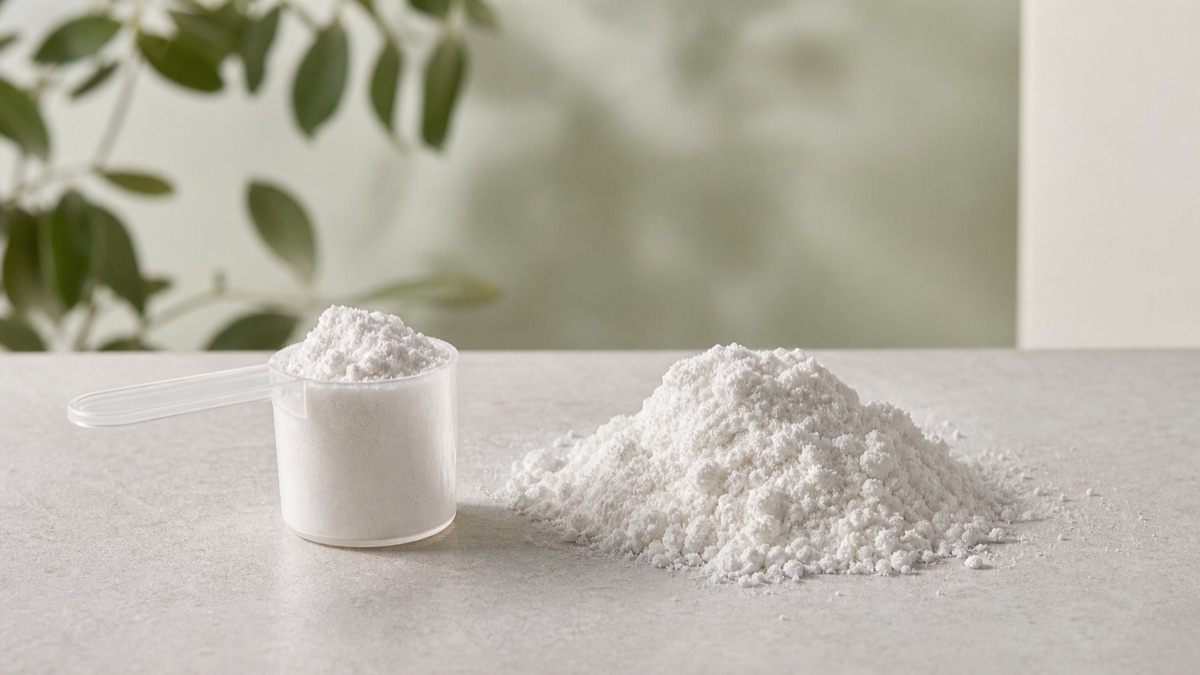
Most supplements ask you to believe a story. Creatine is different. It is cheap, unglamorous, and unusually well studied.
That does not make it magic. Creatine will not compensate for a weak diet, no training, or poor sleep. But if you already do resistance training, are trying to keep strength as you age, or occasionally have to perform while short of sleep, creatine monohydrate is one of the few powders worth taking seriously.
The longevity angle is simple: muscle is not decoration. Strength, power, and the ability to get up from the floor matter more with every decade.
What creatine does
Creatine is a compound your body makes from amino acids and also gets from foods such as meat and fish. Most of it is stored in skeletal muscle as creatine and phosphocreatine.
During short, hard efforts, phosphocreatine helps regenerate ATP, the quick energy currency your muscle cells use when demand spikes. That is why creatine tends to help most with repeated high-intensity work: heavy sets, sprints, jumps, intervals, and training volume.
The NIH Office of Dietary Supplements summarises the evidence this way: creatine may increase strength, power, and work from maximal-effort muscle contractions, and it appears to have little value for endurance sports.
In plain English: creatine helps the training that helps you keep muscle.
Where the benefits hold up
Strength, power, and muscle
This is the strongest part of the evidence. Creatine can improve repeated bursts of high-intensity performance and let some people complete a little more quality work in training. Over time, that can support greater gains in strength and lean tissue when it is paired with resistance training.
The effect is not restricted to young athletes. A meta-analysis of 22 trials in older adults found that adding creatine to resistance training produced greater gains in lean tissue and upper- and lower-body strength than training with a placebo. The average gain in lean tissue was 1.37 kg across studies lasting 7 to 52 weeks. Some of the early increase on the scale is water held in muscle, however, so it should not all be read as new contractile muscle.
Recovery from hard training
Creatine replenishes phosphocreatine between hard efforts, which can help performance across repeated sets or sprints. There is also some evidence that saturated muscle creatine stores support recovery after unusually damaging or exhaustive exercise.
A 2021 systematic review and meta-analysis of nine trials found lower levels of creatine kinase, a marker that often rises after muscle damage, and some improvement in the recovery of muscle function. Results varied substantially between studies and the authors rated the evidence at medium risk of bias, so this is a possible extra benefit rather than a guarantee of less soreness or faster recovery.
There is no well-established special “recovery dose.” The usual 3-5 g daily protocol is intended to keep muscle stores elevated. Loading can do that faster, but taking a large scoop only after one difficult workout is not the same thing.
Cognition
The brain also uses creatine to buffer its energy supply. A 2024 meta-analysis of 16 small randomised trials found a modest benefit for memory, with moderate-certainty evidence. It also reported possible improvements in attention and processing speed, but those findings were low-certainty; there was no clear improvement in overall cognition or executive function. Another 2024 systematic review judged the cognitive findings to be equivocal, so “promising” is more accurate than “proven brain booster.”
Trials have used very different protocols, from 5 g daily for months to 20 g daily for a week. That makes it impossible to name a proven cognitive dose. If you already take 3-5 g daily for training, cognition may be an additional benefit, but the evidence does not yet justify routinely escalating the dose just for sharper thinking.
Sleep deprivation, not better sleep
A 2024 double-blind crossover study in Scientific Reports tested 15 healthy adults aged 20 to 28 during 21 hours of sleep deprivation. A single dose of 0.35 g/kg of creatine monohydrate partially reduced subjective fatigue and improved memory and processing speed compared with placebo. Changes appeared about 3.5 hours after the dose, peaked at roughly four hours, and lasted up to nine hours. Brain scans also showed changes in creatine and high-energy phosphate metabolism consistent with the proposed energy-buffering mechanism.
That is intriguing, but it is not evidence that creatine improves sleep quality, treats insomnia, or replaces sleep. Participants still became sleepier and more fatigued as the night continued. The experiment tested resilience to acute sleep loss in a very small, young sample, not normal daily use.
The dose was also unusually high: 0.35 g/kg is 24.5 g for a 70 kg person, taken at once. The researchers explicitly said that future work must determine the appropriate dose. Because single servings above 10 g are more likely to cause gastrointestinal upset, this experimental dose should not be treated as a routine recommendation or a rescue plan for chronic poor sleep.
Why it matters for longevity
Creatine is not a proven life-extension intervention. It is not caloric restriction in a tub. The case for it is more practical than that.
Ageing makes muscle and power harder to keep. Resistance training is the main intervention. Protein helps. Creatine may be a small amplifier, especially for people whose muscle creatine stores are lower to begin with.
That makes it interesting for:
- Adults doing progressive strength training
- Older adults trying to preserve strength and function
- Vegetarians and vegans, who typically get less creatine from food
- People who want a simple supplement with a better evidence base than most of the shelf
The International Society of Sports Nutrition review on common creatine questions and misconceptions notes that recommended dosing is usually well tolerated, and that creatine has been studied across athletic, older, and clinical populations. The strongest everyday case is still training support, not disease treatment.
What to buy
The boring version is the right version:
- Creatine monohydrate
- Single ingredient
- Powder, not gummies or a proprietary blend
- No stimulant stack
- No “anti-ageing” claims
- Ideally third-party tested
Do not pay extra for a fancier form unless you have a specific reason. Most people do not.
A suitable example is NOW Sports Creatine Monohydrate Powder.
How much to take
| Goal | Amount used or supported | What to know |
|---|---|---|
| Everyday strength, power, and training support | 3-5 g every day | The simplest option. Allow about four weeks to saturate muscle stores. Timing matters much less than consistency. |
| Faster muscle saturation | 20-25 g/day for 5-7 days, split into four or five smaller servings, then 3-5 g/day | Optional. It works faster but brings more early water-weight gain and a greater chance of stomach upset. |
| Recovery from hard training | 3-5 g every day once stores are elevated | Evidence suggests a possible benefit, but there is no proven extra post-workout dose. Food, fluid, sleep, and sensible training load still do most of the recovery work. |
| General cognition | No established dose | Trials range widely, often 5-20 g/day. Evidence is mixed, and higher doses have not been shown to be better for routine use. |
| Acute sleep-deprivation experiment | 0.35 g/kg once | This was the study dose, not a general recommendation. It equals 24.5 g at 70 kg, 28 g at 80 kg, and 31.5 g at 90 kg. The optimal effective and safe protocol is unknown. |
For most people, the first row is the practical answer: 3-5 g of creatine monohydrate daily. Put it in water, yoghurt, a smoothie, or whatever makes it easy to take consistently. If you get stomach upset, skip loading and take the smaller daily dose with food.
What to watch for
The most common downside is scale weight. Creatine can increase water stored with muscle, especially early on. That is not fat gain, but it can be annoying if you are watching body weight closely.
Some people report nausea, diarrhoea, cramps, or stiffness. The NIH fact sheet lists those as reported effects, while also noting few safety concerns at typical doses used in studies.
The kidney worry is more nuanced than internet arguments make it sound. In healthy people using recommended doses, controlled studies have not shown the kidney damage people often fear. But creatine can raise creatinine, a marker clinicians use when interpreting kidney function, and that can complicate lab results.
Talk to a doctor or dietitian before using creatine if you have kidney disease, abnormal kidney blood tests, diabetes with kidney concerns, a history of kidney transplant, complex medication use, pregnancy or breastfeeding, or if the supplement is for someone under 18.
The better rule
Creatine is most useful when it supports the real behaviours: training and recovery.
If the choice is creatine or lifting twice a week, lift. If the choice is a premium blend or plain monohydrate, buy the plain one. If the choice is a supplement routine or enough protein, sleep, and vegetables, start with the boring foundations.
The longevity version is not “take creatine and live longer.” It is this:
Build muscle. Keep power. Recover well. Protect sleep rather than trying to replace it. Creatine may help around the edges.
Sources
- NIH Office of Dietary Supplements: Dietary Supplements for Exercise and Athletic Performance
- Single dose creatine improves cognitive performance during sleep deprivation
- The effects of creatine supplementation on cognitive function in adults: systematic review and meta-analysis
- Creatine supplementation and cognition: a systematic review of equivocal evidence
- Creatine supplementation and recovery following exercise-induced muscle damage: systematic review and meta-analysis
- Creatine during resistance training in older adults: meta-analysis
- Common questions and misconceptions about creatine supplementation
- FDA: Questions and Answers on Dietary Supplements
Affiliate disclosure
This article contains an affiliate link to Amazon. As an Amazon Associate I earn from qualifying purchases.