Study breakdown · Am J Clin Nutr, 2024
Eight Habits, Twenty‑Four Years
The Million Veteran Program followed 719,147 people to ask a blunt question: how much life is a habit actually worth? The answer was larger than almost anyone expected, and it came with conditions.
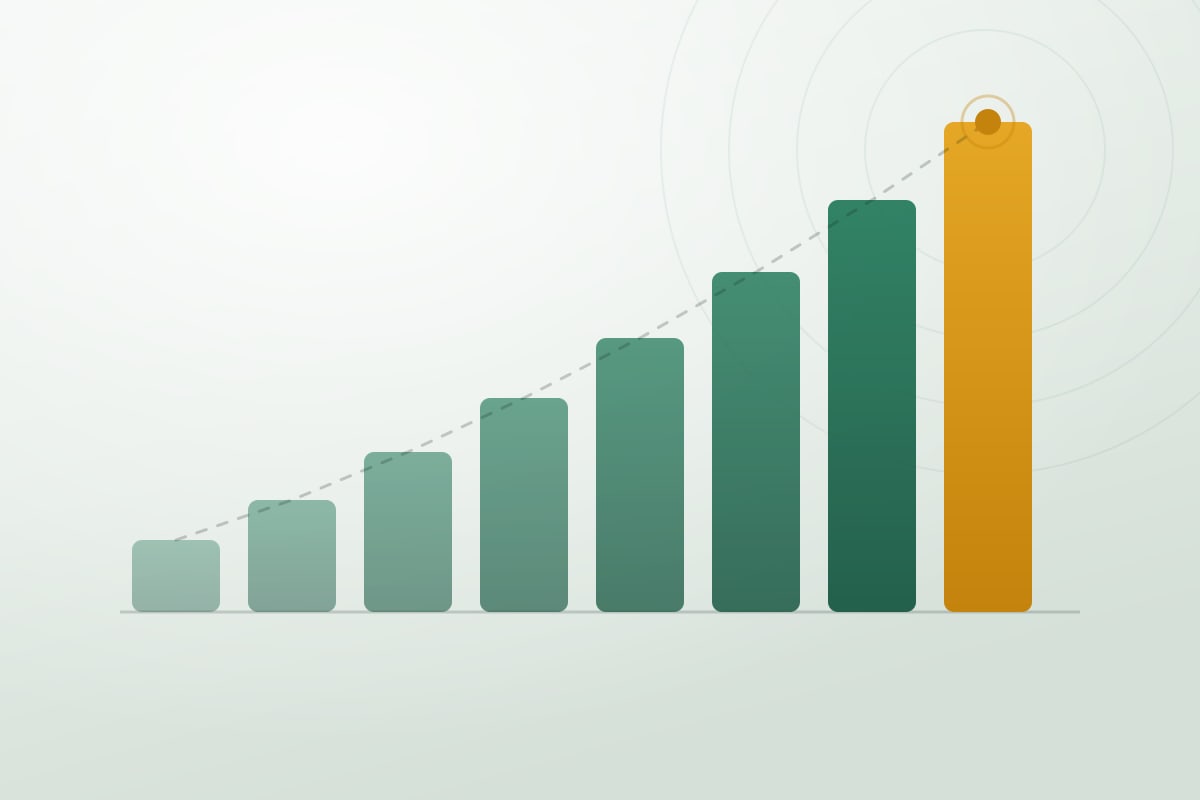
Most longevity research asks whether one thing helps. This study asked what happens when you stack eight of them at once, then put a number on the answer in years of life rather than percentages.
Researchers from the VA, Harvard’s Chan School and Emory drew on the Veterans Affairs Million Veteran Program, one of the largest health databases in the world. They scored participants on eight lifestyle factors measured at baseline, followed who died over the next several years, and modelled what that meant for life expectancy from age 40.
The headline: a 40-year-old man with all eight factors in place had an estimated life expectancy roughly 24 years longer than one with none. For women, the gap was 20.5 years.
The eight factors
These are the ones the study scored. Note what is here and what is not: no supplements, no biomarkers, no medical interventions. Two of the eight are about your mind and your relationships rather than your body.
Never smoking
Never having taken up the habit, not merely having quit.
Physical activity
Regular movement, the most consistently protective factor across the literature.
No excess alcohol
Scored as the absence of heavy drinking, not total abstinence.
Restorative sleep
Sleep that actually restores. Duration and quality both count.
Nutrition
A diet quality score, not a named diet or a macro ratio.
Stress management
An active practice, treated here as a habit rather than a personality trait.
Social connections
Relationships scored alongside diet and exercise as a physical health factor.
No opioid use disorder
Specific to this cohort's risk profile, and a large effect within it.
Finding 1: risk falls in a straight, unbroken line
There was no threshold and no plateau. Every additional factor lowered mortality risk, and the last one lowered it about as much as the first.
Compared with people who had none of the eight, adopting a single factor cut the risk of dying during follow-up by roughly a quarter. Adopting all eight cut it by 87%.
Finding 2: in years, the gap is enormous
Hazard ratios are hard to feel. So the team converted them into estimated life expectancy at age 40, which is the number that actually lands.
A 40-year-old man with none of the eight had an estimated 23 years left. With all eight, 47. That is a difference of 24 years, or the distance between dying in your early sixties and living into your late eighties. For women the figures ran from 27 years to 47.5, a gap of 20.5 years.
The women’s curve starts higher and climbs more steeply through the early factors, then converges with the men’s at the top end. Both end up in nearly the same place. The men simply have further to travel.
Stack them yourself
Interactive
Eight factors, one estimate
Switch factors on to see what the study's model estimated for a 40-year-old with that many in place.
The study reported results by how many factors people had, not by which ones. So this counts your selections. It cannot tell you that sleep is worth more than nutrition, because the paper does not say.
What this study cannot tell you
This is where most coverage of the paper stops, and it should not. The findings are striking precisely because the design has limits worth naming.
- It is observational. Nobody was assigned to a lifestyle. People who exercise, sleep well and stay socially connected differ from people who do not in a hundred ways the model cannot fully adjust for.
- Reverse causation is live. Early, undiagnosed illness makes people less active, less social and worse sleepers. Some of the gap may be sickness causing the habits rather than the habits preventing sickness.
- It is veterans. Overwhelmingly male, skewed older, with a different baseline health and risk profile from the general population. The opioid factor in particular reflects this cohort.
- The years are modelled. Life expectancy here is a projection from hazard ratios over a 2011 to 2019 window, not 24 years of observed extra living.
None of that makes the result uninteresting. A dose-response relationship this clean, across this many people, in this direction, is exactly the pattern you would expect if the effect were real. It is just not the same thing as proof that adding factor number eight buys you a specific number of birthdays.
What to take from it
Three things hold up well.
Stacking beats optimising. The gain from your first factor is roughly the same size as the gain from your eighth. Someone doing none of these gets more out of starting anywhere than a diligent exerciser gets out of a better training programme.
Stress and social connection are health behaviours. Two of the eight are things most people file under “personal life” rather than “health,” and the study scored them alongside smoking and diet without apology.
Forty is not late. The whole model starts at 40. The entire 24-year spread is available to a middle-aged adult, not just to someone who got it right at twenty.
Want a version of this arithmetic for your own habits? Our longevity calculator turns diet, sleep, exercise and the rest into a life-expectancy estimate, with the assumptions shown.