Doctors' diets, compared
What Longevity Doctors Put in the Cart
Six clinicians and researchers have published what they actually buy and eat. The brands differ. The cart does not.
Physician grocery lists make good headlines. They also make a useful experiment: if you ignore the brand names and line up what respected doctors say they eat, avoid, and why, does a shared pattern emerge?
It does. Across a heart surgeon’s weekly essentials, a cardiologist’s ultra-processed crackdown, a plant-based checklist, a longevity researcher’s pescatarian template, a high-protein longevity protocol, and a heart-disease-reversal diet, the overlap is larger than the internet argument suggests.
This is not medical advice and not a claim that any one doctor’s personal plate is optimal for you. It is a reading of published diets and shopping habits, with sources at the end. Personal anecdotes sit beside the evidence each person cites; treat them as patterns, not prescriptions.
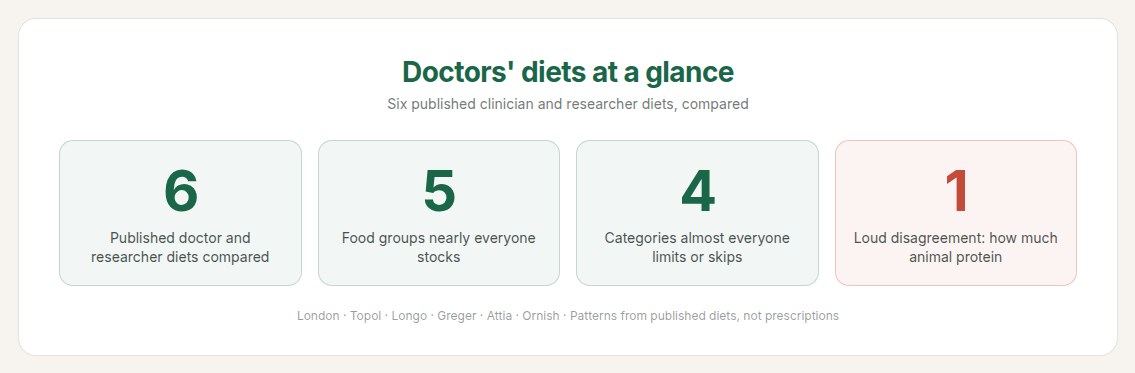
The consensus map
Read the infographic as a Venn diagram flattened into three rings. The centre is what shows up in almost every list. The middle ring is common but not universal. The outer ring is where the doctors genuinely part company.
Comparison matrix
The full detail for each doctor follows below. Read the table for the shape of the disagreement: the first five rows barely move from one column to the next, and the last four are where the arguments live.
| Jeremy London, MD | Eric Topol, MD | Valter Longo, PhD | Michael Greger, MD | Peter Attia, MD | Dean Ornish, MD | |
|---|---|---|---|---|---|---|
| Lens | Heart surgeon, weekly grocery essentials | Cardiologist, Super Agers | Longevity Diet and fasting research | Daily Dozen, whole-food plant-based | Outlive, protein and metabolic health | Clinical program for reversing heart disease |
| Pattern | Whole-food omnivore, lean protein | Mediterranean, mostly plants | Pescatarian, plant-forward | Strict plant-based checklist | High-protein, personalised macros | Very low-fat vegetarian |
| Vegetables | Broccoli, peppers, cucumber, sweet potato, spinach | Produce-heavy cart, salads at night | High volume, tomatoes and crucifers | Crucifers, greens and other veg daily | Fibre-rich vegetables by default | Unlimited, leafy and colourful |
| Fruit | Cherries, berries, banana, apple, mango | Berries with yogurt at breakfast | Vegetables first, fruit moderated for sugar | Berries plus other fruit daily | Whole fruit over juice | Freely, though juice is no free pass |
| Fibre staples | Oats, quinoa, lentils, beans, chia | Legumes, whole grains, nuts | Legumes first, then whole grains | Beans 3x and grains 3x a day, flax | Fibre from plants, no refined carbs | Whole grains and legumes at the core |
| Protein | Turkey, chicken, wild salmon and cod, Greek yogurt, eggs | Poultry and seafood, no red meat in 40 years | Fish 2 to 3 times a week, low protein under 65 | Beans, lentils, soy. No meat or fish | About 1 g per lb body weight, any quality source | Legumes, soy, egg whites, nonfat dairy |
| Fats | Olive oil, nuts, avocado, fatty fish | Olive oil and nuts, Mediterranean fats | Olive oil ~3 tbsp and nuts ~1 oz daily | Nuts, seeds and flax, minimal added oil | Unsaturated fats within the calorie budget | Under 10% of calories, no added oils or nuts |
| Usually avoids | Hot dogs, deli meat, soda, pastries, alcohol | Ultra-processed "UFOs", red meat, excess salt and sugar | Red and processed meat, sugar, refined grains | Meat, dairy, eggs, added salt, oil and sugar | Sugary drinks, refined junk carbs, late eating | Meat, fish, egg yolks, oils, full-fat dairy |
| Stated why | Fibre lowers ApoB and feeds the microbiome | Mediterranean evidence and an anti-inflammatory plate | Slow the nutrient-sensing pathways tied to ageing | Nutrient density and prevention literature | Preserve muscle, control metabolic markers | Lifestyle trials on reversing coronary disease |
Doctor by doctor
1. Jeremy London, MD: heart surgeon’s cart
In a 2026 CNBC Make It essay, cardiothoracic surgeon Jeremy London describes rebuilding his shopping after his own heart attack. His rule of thumb: spend about 80% of shopping time on the store perimeter (produce and perishables) and 20% or less in the inner aisles.
He buys: broccoli, bell peppers, cucumbers, sweet potatoes, spinach, carrots; cherries, blueberries, bananas, apples, strawberries, blackberries, mangos, oranges; steel-cut or rolled oats, quinoa, lentils, mixed beans, chia; ground turkey and chicken, chicken breast, wild salmon and cod, Greek yogurt, eggs; extra virgin olive oil, cashews, almonds, walnuts, pistachios, Brazil nuts, avocado.
He rarely buys: hot dogs, deli meats, regular soda, white bread (sourdough preferred), pastries, donuts, cakes, and alcohol.
Why he says so: fibre helps lower ApoB and feeds the gut microbiome; lean protein protects muscle and satiety without a heavy saturated-fat load; nuts, olive oil, avocado, and fatty fish supply anti-inflammatory fats and help absorb fat-soluble vitamins. His label heuristic is short: ignore the front of the package, prefer short ingredient lists, and avoid added sugars and preservatives.
2. Eric Topol, MD: Mediterranean, minus the UFOs
Cardiologist Eric Topol, author of Super Agers, has described a cart that is now “largely just fresh produce.” In interviews with Business Insider, TODAY, and AARP, he endorses a Mediterranean pattern and has not eaten red meat for roughly four decades.
He emphasises: vegetables, fruit, legumes, whole grains, nuts, olive oil, poultry and seafood in moderation; breakfast of nonfat Greek yogurt, berries, and low-sugar granola; salads at night; about 25-30 g fibre per day.
He avoids: ultra-processed packaged foods he nicknames “UFOs,” excess salt and sugar, artificial sweeteners, and additive-heavy labels. Frozen vegetables and plain canned beans still count as useful, not ultra-processed.
Why he says so: he points to long Mediterranean-diet trials and cohort data on healthy ageing, and to the idea that ultra-processed foods are “the polar opposite” of fibre: pro-inflammatory and linked with metabolic disease.
3. Valter Longo, PhD: the Longevity Diet
USC longevity researcher Valter Longo has published a daily Longevity Diet and summarised it in Cell with Rozalyn Anderson: mostly plants, some fish, time-restricted eating, and periodic fasting-mimicking cycles for higher-risk people.
He eats: lots of legumes, whole grains, and vegetables; fish two to three times a week (favouring omega-3-rich, lower-mercury options); olive oil (~3 tablespoons/day) and nuts (~1 ounce/day); dark chocolate as an evening ritual in interviews; eating confined to about a 12-hour window.
He limits or avoids: red meat and processed meat, excess white meat, sugar, refined grains; fruit is moderated relative to vegetables because of sugar load. Protein stays relatively low before age 65 and rises modestly later to protect muscle.
Why he says so: the pattern is meant to nudge nutrient-sensing pathways tied to ageing while matching centenarian and clinical evidence. It is a research protocol more than a grocery-influencer list, but the cart still looks Mediterranean-pescatarian.
4. Michael Greger, MD: the Daily Dozen
Greger’s Daily Dozen is a checklist, not a macro split: beans, berries, other fruit, cruciferous vegetables, greens, other vegetables, flaxseeds, nuts and seeds, herbs and spices, whole grains, beverages, and exercise. When he controls his own kitchen, he aims for whole plant foods without added salt, oil, or sugar, and finishes eating by late afternoon.
He eats: legumes multiple times a day, berries and other fruit, greens and crucifers, oats/buckwheat/barley-style grains, flax and nuts, herbs such as turmeric, water and unsweetened tea.
He avoids (personally): meat, dairy, eggs, and the salt-oil-sugar trio when home-cooked meals are under his control.
Why he says so: he frames the Dozen as a practical summary of foods that repeatedly show up in disease-prevention evidence, emphasising nutrient density rather than calorie counting.
5. Peter Attia, MD: protein first, junk last
In Outlive and related interviews, Attia rejects a single “best diet.” His non-negotiables are energy balance, metabolic health, adequate protein, micronutrients, and adherence. Practically, that means a much higher protein target than Longo or Greger, often cited around 1 gram per pound of body weight, distributed across the day, plus a hard line against sugar-sweetened beverages and refined junk.
He emphasises: high-quality protein (meat, fish, dairy, or supplements as needed), vegetables and fibre, whole fruit instead of juice, fats that fit the calorie budget, and stopping food a few hours before bed.
He avoids: fructose-sweetened drinks (soda and juice), highly refined low-fibre carbohydrates, and the calorie-dense packaged foods of the standard Western diet.
Why he says so: preserving muscle and metabolic flexibility into older age; glucose and energy balance as measurable outcomes rather than ideological food tribes.
6. Dean Ornish, MD: reverse the plaque, restrict the fat
Ornish’s program is the most restrictive fat rule in this set: roughly under 10% of calories from fat, built as a low-fat vegetarian pattern used in trials of coronary disease reversal. Whole grains, vegetables, fruit, legumes, and soy sit at the centre; egg whites and nonfat dairy appear on the classic plan.
He includes: vegetables, fruit, whole grains, beans, soy foods, herbs and spices; limited nonfat dairy and egg whites on the standard reversal diet.
He excludes on the classic reversal diet: meat, poultry, fish, egg yolks, added oils, nuts, seeds, avocados, olives, and most caffeinated drinks except green tea.
Why he says so: randomised and controlled lifestyle trials linking very low saturated fat and whole-food vegetarian eating with improvements in coronary risk markers and events. It is a therapeutic protocol, which is why it collides with Mediterranean olive-oil advice elsewhere in this table.
Where they agree
Strip away the branding and five shopping rules survive almost intact:
- Fill the cart with plants. Vegetables, fruit, legumes, and whole grains appear on every list.
- Treat ultra-processed food as the common enemy. London’s “longer shelf life, shorter life,” Topol’s UFOs, Attia’s war on sugary drinks, and Greger’s salt-oil-sugar rule are different slogans for the same aisle.
- Protect fibre. Oats, beans, greens, nuts, and seeds show up because fibre is the quiet through-line for ApoB, satiety, microbiome, and glycaemia.
- Prefer short labels. If a package needs a marketing paragraph on the front, flip it over or put it back.
- Shop with a plan. Lists beat hunger; perimeter produce beats impulse endcaps.
Those five map cleanly onto the food groups linked to lower mortality in the Schwingshackl food-group meta-analysis and the practical plate in 12 foods for longevity.
Where they fight
The fight is mostly about animal protein and added fat:
- Attia and London keep lean meats and eggs in weekly rotation for muscle and convenience.
- Topol and Longo keep fish and sometimes poultry, but red meat is rare to never.
- Greger drops animal products entirely when he controls the kitchen.
- Ornish drops fish and most fats, including the olive oil and nuts that Longo, London, and Topol prize.
That is a real scientific tension (protein for sarcopenia versus animal-food risk signals; olive oil Mediterranean trials versus very-low-fat reversal trials), not a failure of the consensus map. For a non-patient reader without a clinician-directed protocol, the low-regret middle looks like: plants as the default, fish if you eat seafood, nuts and olive oil in food-like amounts, and processed meat and sugary drinks left on the shelf.
A consensus shopping list
If you want one cart that does not pretend the doctors agree on steak or avocado:
| Stock most weeks | Buy often | Leave behind |
|---|---|---|
| Leafy greens, crucifers, colourful vegetables | Fatty fish (if you eat it), eggs or Greek yogurt (if you eat them), extra virgin olive oil | Hot dogs, deli meats, regular soda |
| Berries and other whole fruit | Legumes (dry or plain canned), oats, quinoa or other intact grains | Pastries, donuts, candy aisles |
| Nuts and seeds (unless following Ornish-style fat limits) | Fermented options you enjoy (plain yogurt, sauerkraut) as extras, not magic | Packages with long additive lists and front-of-box health claims |
That list is closer to London’s perimeter rule and Topol’s produce cart than to any influencer cleanse. It is also closer to what mortality meta-analyses keep rewarding.
How to use this without becoming a disciple
Pick the constraints you will actually keep. An 80/20 whole-food pattern you sustain beats an Ornish-perfect week you abandon. If you already have heart disease, kidney disease, or a clinician-directed diet, their advice outranks any amalgam on a website.
For a dose-response view of food groups rather than doctor brands, use the longevity calculator. For the plant-and-fish staples that keep recurring outside celebrity diets, see 12 foods worth eating for longevity.
Sources
- Jeremy London, CNBC Make It (2026): I’m a heart surgeon: These are my weekly grocery essentials
- Eric Topol interview, Business Insider (2025): How to grocery shop to avoid ultra-processed food
- Eric Topol, TODAY: habits for healthy ageing / Mediterranean diet
- Eric Topol profile, AARP: daily habits and Mediterranean pattern
- Valter Longo: Daily Longevity Diet for Adults
- Longo & Anderson, Cell (2022): Nutrition, longevity and disease: from molecular mechanisms to interventions
- USC Gerontology summary of Longo’s longevity diet
- Michael Greger / NutritionFacts: Daily Dozen
- Peter Attia, AMA #75: how to evaluate diets
- Peter Attia, Outlive (2023): dietary restriction, protein, and metabolic health, discussed in secondary summaries such as Hone Health’s overview
- Cleveland Clinic: What is the Ornish diet?
- Ornish Lifestyle Medicine: plant-based eating guidelines
- Schwingshackl et al., AJCN 2017: Food groups and risk of all-cause mortality
- Longtime: 12 food groups and mortality
- Longtime: 12 foods worth eating for longevity