The longevity plate
12 Foods Worth Eating for Longevity
Nutrient-dense staples that show up again and again in mortality research: leafy greens, berries, nuts, fish, legumes, and the colourful plants that fill a longevity plate.
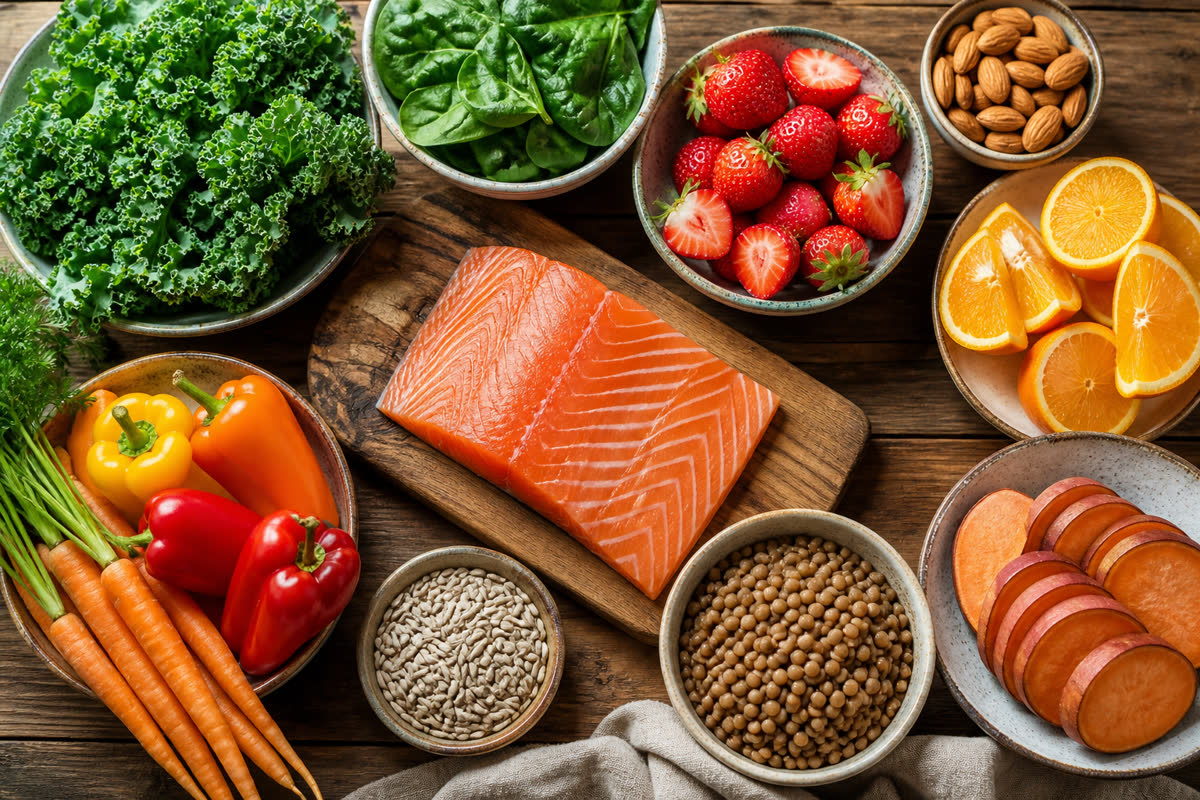
Longevity diets are usually sold as patterns, not shopping lists. That is the right instinct. No single food is a multivitamin that cancels smoking, sleep debt, or a sedentary decade.
Still, some foods earn a permanent seat on the plate. They are dense in fibre, polyphenols, unsaturated fats, carotenoids, and micronutrients that are hard to overconsume in whole-food form. They also map onto the food groups that Schwingshackl et al. linked to lower all-cause mortality: vegetables, fruit, nuts, legumes, whole grains, and fish.
Below are 12 foods that do that job well. Most are the classic “nature’s multivitamin” staples that keep circulating in wellness roundups; legumes are the longevity staple those lists often forget. The stats are population associations and nutrient facts, not personal prescriptions.
How to read this list
Three rules keep the list honest:
- Food groups beat food fads. Kale is useful because leafy vegetables are useful, not because kale has a brand.
- Dose plateaus. Most benefits flatten: more fruit and nuts help up to a point, then returns shrink.
- Substitution matters. An orange that replaces a sugary drink is doing different work from an orange on top of an already high-fibre diet.
For the dose-response curves behind the calculator on this site, see 12 food groups and mortality.
1. Kale
Kale is a compact delivery system for vitamins A, C, and K, plus lutein, fibre, and plant nitrates. Dark leafy greens sit inside the vegetable group that Schwingshackl linked to lower mortality, with most of the benefit arriving by roughly 250–300 g/day of vegetables overall.
Practical use: sauté with olive oil and garlic, shred into soups, or massage with lemon as a salad base. Frozen kale counts.
2. Spinach
Spinach overlaps with kale on micronutrients and adds a high nitrate load that can support vascular function in short feeding studies. Observational work on leafy-green intake consistently tracks with lower cardiovascular risk; the mechanism story (nitrates → nitric oxide → vessel tone) is one of the cleaner plant-food explanations.
Practical use: wilt into eggs, blend into smoothies, or keep a washed box for weekday volume.
3. Strawberries
Berries punch above their calorie weight. A 2016 BMJ meta-analysis found each daily serving of berries associated with about 8% lower cardiovascular disease risk. Strawberries also bring vitamin C, fibre, and anthocyanins without much sugar relative to many desserts.
Practical use: whole fruit over juice; freeze when cheap; add to yoghurt or oats rather than baking into sugar bombs.
4. Almonds
Nuts are one of the steepest per-serving mortality signals in food-group research. Schwingshackl reported roughly 24% lower mortality per 28 g/day in linear analysis, with the nonlinear curve flattening around 15–20 g/day. Almonds specifically supply vitamin E, unsaturated fat, fibre, and magnesium.
Practical use: a small handful (about 20–30 g), not a grazing bag. Dry-roasted or raw beats candy-coated.
5. Salmon
Fatty fish is the cleanest animal food in most longevity patterns. Fish intake up to about 200 g/day tracked with roughly 10% lower all-cause mortality in the 2017 meta-analysis. Salmon also delivers EPA/DHA omega-3s, high-quality protein, and vitamin D.
Practical use: two fish meals a week is a realistic target for most people. Canned salmon is cheaper and still counts. If you avoid fish, the rest of this list still matters; fish is not mandatory for every diet, but it is hard to beat for omega-3 density.
6. Legumes (the one the multivitamin lists skip)
Beans, lentils, chickpeas, and peas are Blue Zone staples and a core protective food group. Nonlinear models in Schwingshackl suggested about 10–16% lower mortality toward 100–150 g/day cooked legumes. They also deliver fibre, potassium, plant protein, and slow carbs that help satiety.
Practical use: a daily scoop of lentils, black beans, or chickpeas. Canned (rinsed) is fine. This is the food most “nature’s multivitamin” roundups omit, and the one longevity cohorts keep endorsing.
7. Sweet potatoes
Sweet potatoes are rich in beta-carotene (a vitamin A precursor), vitamin C, potassium, and fibre, with a gentler glycaemic profile than many refined starches when eaten as whole food. Orange vegetables sit inside the broader vegetable pattern associated with lower mortality and better carotenoid status.
Practical use: bake, roast, or mash with the skin when you can. Treat them as a vegetable-starch hybrid, not a dessert just because they are sweet.
8. Oranges
One medium orange provides on the order of 70 mg of vitamin C, plus flavanones such as hesperidin and useful potassium. Whole citrus contributes to the fruit intake associated with lower mortality in cohorts; fruit juice is a different product and should not be treated as equivalent (see whole fruit versus juice).
Practical use: eat the fruit, keep juice occasional and small. Pair with a meal if you monitor glucose.
9. Eggs
Eggs are nutrient-dense: high-quality protein, choline, B12, and some vitamin D. The mortality story is milder than older cholesterol panic suggested. Larger modern analyses generally find no clear harm at about one egg a day or less in otherwise healthy diets, though evidence quality has limits and context (overall diet, diabetes status) still matters.
Practical use: a few eggs a week as a protein garnish fits most longevity patterns. Do not fear them; do not build every breakfast around a three-egg fry-up either.
10. Sunflower seeds
Seeds are the overlooked sibling of nuts. An ounce of sunflower seeds provides roughly 7 mg of vitamin E (about half the daily value for many adults), plus unsaturated fats, magnesium, and selenium. They fill micronutrient gaps that show up when diets are low in nuts and seeds overall.
Practical use: sprinkle on salads and yoghurt, or swap a share of snack nuts for seeds. Watch portions; they are calorie-dense.
11. Carrots
Carrots are a carotenoid workhorse: alpha- and beta-carotene that the body can convert toward vitamin A, plus fibre. Higher circulating carotenoids track with lower mortality in observational work, and carrot intake is an easy way to raise that status without supplements.
Practical use: raw, roasted, or soup. Cooking with a little fat improves carotenoid absorption.
12. Bell peppers
Peppers, especially red ones, can outcompete oranges on vitamin C per serving and add carotenoids plus crunch that displaces ultra-processed snacks. They are an easy route to higher vegetable volume, which is where most of the longevity benefit lives.
Practical use: roast, stuff, or slice raw. Colour variety is useful; red and orange peppers are usually richer in carotenoids than green.
What the numbers add up to
Stack the protective food groups at roughly optimal intakes (about three servings each of whole grains, vegetables, and fruit; one of nuts; one of legumes; two of fish) and the 2017 modelling produced a 56% relative reduction in all-cause mortality versus eating none of those foods. That figure is illustrative. It assumes associations are roughly additive and that confounding is controlled. Real life is messier.
What holds up is the direction:
- More whole plants, nuts, legumes, and fish
- Fewer processed meats and sugar-sweetened drinks
- Colour and fibre as daily defaults, not weekend projects
If you want to see how your current plate compares with these curves, use the longevity calculator.
A simple weekly template
You do not need all 12 every day. Aim for a rotation:
| Most days | Several times a week | Watch the dose |
|---|---|---|
| Leafy greens, carrots or peppers, fruit (berries or citrus), nuts or seeds | Salmon or other fish, legumes, sweet potato | Eggs (moderate), dried fruit, juice |
Buy frozen berries and greens if fresh is expensive. Canned fish and beans are longevity foods in disguise. The winning pattern is boring repetition, not a perfect Instagram bowl.
Bottom line
These 12 foods are not magic. They are dense, mostly plant-forward options that make it easier to hit the intakes linked to longer life in cohort research. Eat them as whole foods, keep portions sensible for nuts and seeds, and treat the list as a pantry, not a purity test.
Sources
- The Honour System / Flipboard: 11 foods that are basically nature’s multivitamin
- Schwingshackl et al., AJCN 2017: Food groups and risk of all-cause mortality
- Aune et al., BMJ 2016: Fruit and vegetable intake and risk of cardiovascular disease, cancer and mortality
- Aune et al., BMC Medicine 2016: Nut consumption and risk of cardiovascular disease, total cancer, all-cause and cause-specific mortality
- Drouin-Chartier et al., BMJ 2020: Egg consumption and risk of cardiovascular disease
- USDA FoodData Central: nutrient profiles for oranges, sunflower seeds, peppers, and related foods
- Wang et al., Circulation 2021: Fruit and vegetable intake and mortality
- Longtime: 12 food groups and mortality