New review · Cell Press Blue, 2026
The Protein Paradox of Ageing
Protein protects ageing muscle, yet restricting protein and certain amino acids can extend life in animals. A new review explains why both can be true.
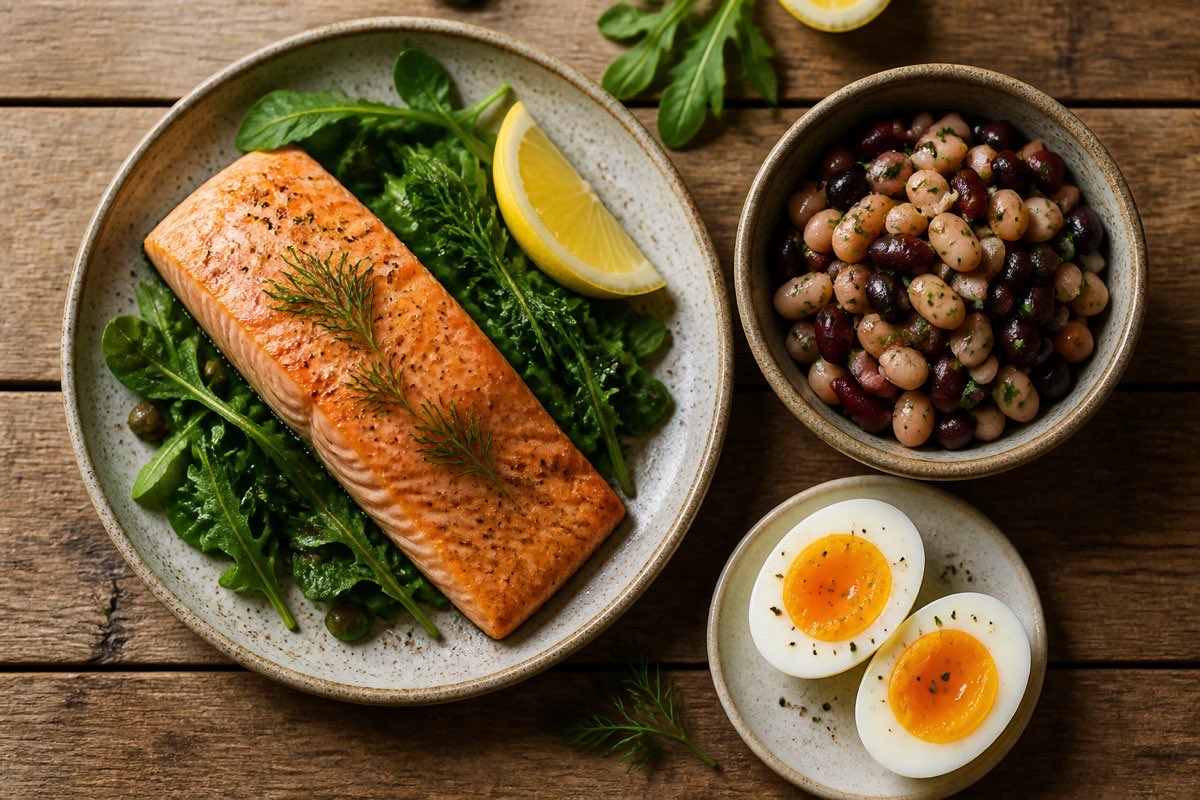
Protein has acquired the glow of a health halo. It is added to cereal, yoghurt, snack bars, ice cream, and water, while fitness advice often treats more as self-evidently better. Then ageing research delivers the opposite message: restrict protein, quiet the body’s growth signals, and perhaps live longer.
Both ideas contain some truth. Protein helps preserve muscle, strength, and independence. In laboratory animals, eating less protein—or less of particular amino acids—can improve metabolic health and extend lifespan. The mistake is assuming that one of these findings must cancel the other.
A substantial new review by Bailey Knopf and Dudley Lamming, The hallmarks of protein and amino acid restriction in aging and longevity, pulls together more than 350 papers on this tension. It is a useful map of the biology, but not an instruction to put older people on low-protein diets.
The practical lesson is less dramatic and more interesting: the right amount of protein depends on age, activity, health, and what the protein replaces. There is no single longevity number.
What the new review actually found
This is a narrative review, not a new clinical trial. Its authors examine how restricting total protein or individual amino acids affects several processes involved in ageing:
- Metabolic health and insulin sensitivity
- Nutrient-sensing pathways such as mTOR and insulin-like growth factor 1 (IGF-1)
- Cellular senescence, when damaged cells stop dividing but remain biologically active
- Mitochondrial function and energy use
- Epigenetic regulation, the chemical controls that influence which genes are active
Across yeast, worms, flies, and rodents, protein restriction often improves healthspan and sometimes lifespan. Restricting methionine, isoleucine, or valine can reproduce parts of the effect, suggesting that amino acid composition matters as well as the total number of protein grams.
That is the exciting part. Here is the restraint it needs: most of the lifespan evidence comes from organisms that are not human. The effects can differ by species, strain, sex, age, and the calories or nutrients used to replace protein. Human studies are generally observational, small, brief, or designed to measure metabolic markers rather than lifespan.
No long-term randomised trial has shown that protein restriction extends human life. Restricting a single essential amino acid is an experimental strategy, not a diet ready for home use.
Why eating less protein can look good in a laboratory
Amino acids do more than provide building material. They are also signals. When amino acids are abundant, the body receives a message that conditions are good for growth.
One recipient is mTORC1, a nutrient-sensing complex involved in cell growth and protein synthesis. Another is the growth hormone and IGF-1 network. These systems are essential for development, repair, and muscle building. But chronically high growth signalling may also suppress cellular housekeeping, support the growth of damaged cells, and contribute to diseases of ageing.
Protein restriction can turn down parts of that signal. It can also raise fibroblast growth factor 21 (FGF21), a hormone involved in the body’s response to low protein. In male mice, FGF21 is required for protein restriction to produce some of its metabolic and lifespan benefits.
A small 2025 human feeding study shows that at least part of this machinery also operates in us. Healthy young men reduced their intake from at least 1.5 g/kg/day to 0.8 g/kg/day for five weeks while researchers adjusted calories to keep their weight stable. FGF21 rose, and the men needed more energy to maintain the same weight. The study demonstrates a metabolic response to lower protein; it does not show slower ageing or longer life.
The amino acid details are even less settled. Methionine influences the cell’s methylation chemistry. Isoleucine and valine are branched-chain amino acids connected to metabolic signalling. In mice, restricting them can improve glucose regulation and alter frailty or lifespan, but the results are sometimes sex-specific. Reducing all three branched-chain amino acids can also affect senescent cells differently in liver and fat tissue.
Biology is not offering a simple “less is better” dial. It is revealing a network of trade-offs.
Why eating enough protein becomes more important with age
The other side of the paradox is visible without a microscope. From midlife onward, adults tend to lose muscle mass, strength, and power. Illness, inactivity, weight loss, and a smaller appetite can accelerate that decline.
Older muscle is also less responsive to a small protein dose, a phenomenon often called anabolic resistance. That is one reason expert groups commonly recommend about 1.0–1.2 g/kg/day for healthy adults over 65 rather than treating the minimum adult intake as an ideal target for everyone.
Yet this case is sometimes oversold too. A systematic review of 18 randomised trials found insufficiently convincing evidence that raising protein above 0.8 g/kg/day improved health outcomes in generally healthy older adults who were already consuming at least that amount. A more recent overview of meta-analyses likewise found no routine improvement in muscle, strength, or physical performance from protein supplements in healthy older people. Benefits were clearer for some people with long-term conditions, and when extra protein accompanied exercise.
That distinction matters. Correcting a low intake in a frail, undernourished, or training older adult is not the same intervention as adding a shake to the diet of a healthy person who already eats enough.
Protein is support, not the stimulus. Resistance training gives muscle a reason to adapt. Without that loading, simply eating more has limited power to preserve function.
Does the ideal amount change at 65?
One influential human study appears to suggest an age switch. Researchers followed adults from the US NHANES III survey and found that higher protein intake was associated with greater mortality among people aged 50–65, while adults over 65 with low protein intake had higher mortality.
This finding helped popularise the advice to eat lower protein in middle age and raise it after 65. It is intriguing, but age 65 is not a biological light switch. The study was observational, protein intake was estimated from a single 24-hour dietary recall, and illness can cause both a lower appetite and a higher risk of death. Its striking age interaction is a hypothesis to test, not a personalised feeding schedule.
The safer conclusion is broader: the balance of risks changes. A younger, sedentary, well-fed adult may have little to gain from turning every meal into a protein delivery system. An older adult losing weight, muscle, or strength may have a great deal to lose from aggressive restriction.
Amount, source, and the rest of the plate
Asking only “how many grams?” leaves out half the diet.
A steak, a bowl of lentils, a piece of fish, and a protein bar can contain similar amounts of protein while bringing very different amounts of fibre, saturated fat, sodium, micronutrients, and processing. Replacing beans with processed meat is not nutritionally equivalent to replacing refined carbohydrates with beans.
A plant-forward pattern generally delivers a different amino acid mix, often with less methionine per calorie, although individual foods vary widely. More importantly, legumes, nuts, seeds, and whole grains arrive with fibre and other useful nutrients. This pattern may therefore moderate amino acid exposure without requiring anyone to calculate the methionine content of lunch.
That does not mean animal protein is inherently harmful or that vegan diets automatically provide the right amount. Fish, eggs, yoghurt, and lean meat can fit a healthy pattern. A strictly plant-based diet can also fall short if appetite is low, food variety is narrow, or total energy intake is inadequate.
The most defensible approach is to optimise the whole pattern:
- Avoid chronic excess for its own sake. Most healthy, non-athletic adults do not need a bodybuilding intake of 1.6–2.2 g/kg/day.
- Do not drift below adequacy. In Australia and New Zealand, the adult reference values are about 0.84 g/kg/day for men and 0.75 g/kg/day for women, rising after age 70.
- Adjust for context. Healthy older adults are often guided toward 1.0–1.2 g/kg/day. Frailty, illness, weight loss, hard training, or recovery can change the target and may justify professional advice.
- Put plants at the centre. Use beans, lentils, chickpeas, tofu, tempeh, nuts, seeds, and whole grains regularly, with other protein sources according to preference and need.
- Train the tissue you want to keep. Progressive resistance exercise matters more than fine-tuning an amino acid that has extended life in mice.
For the numbers in common situations, see our fuller guide to how much protein you actually need.
Do not try to restrict one amino acid yourself
Essential amino acids are called essential because the body cannot make enough of them. A diet designed to suppress methionine, isoleucine, or valine could easily become low in total protein, energy, or other nutrients. Food-composition databases are not precise enough to turn this into reliable kitchen pharmacology, and the human outcome data do not justify it.
The research may eventually produce carefully formulated diets, short-term interventions, or medicines that mimic part of the low-protein response. That is different from deliberately becoming protein deficient.
People with chronic kidney disease also need condition-specific advice. Some are advised to moderate protein, while people receiving dialysis or living with malnutrition may need more. Copying either a longevity diet or a fitness diet can be inappropriate.
The bottom line
The new review makes a strong case that protein is not merely building material. Its quantity and amino acid composition change nutrient sensing, metabolism, and several hallmarks of ageing.
It does not establish that humans live longer by eating less protein. Nor does the muscle literature show that every older adult benefits from eating as much protein as possible.
The useful middle ground is not glamorous enough for a supplement label: eat enough for your age and circumstances, avoid excess without a purpose, favour a plant-rich food pattern, and pair protein with resistance training. As frailty risk rises, protecting muscle deserves more weight in the calculation.
Longevity is not a contest between mTOR and your quadriceps. The goal is to preserve both cellular maintenance and the strength to use the years you have.
Sources
- Knopf and Lamming: The hallmarks of protein and amino acid restriction in aging and longevity
- Nicolaisen et al.: Dietary protein restriction elevates FGF21 levels and energy requirements in lean men
- Richardson et al.: Lifelong branched-chain amino acid restriction has sex-specific effects in mice
- Calubag et al.: Tissue-specific effects of dietary protein and branched-chain amino acids on cellular senescence
- Levine et al.: Protein intake, IGF-1, and mortality by age group
- Hengeveld et al.: Increasing protein intake in older adults, systematic review
- Clegg et al.: Effects of supplemental protein in older people, overview of meta-analyses
- PROT-AGE recommendations for older adults
- Australia and New Zealand Nutrient Reference Values: Protein