Evidence review · the vitality shelf
Which supplements actually help you live longer
Male vitality formulas promise more testosterone, more muscle, and a longer life. The evidence for most of the ingredients is thinner than the label, and the ones that matter usually work by correcting a deficiency rather than reversing ageing.
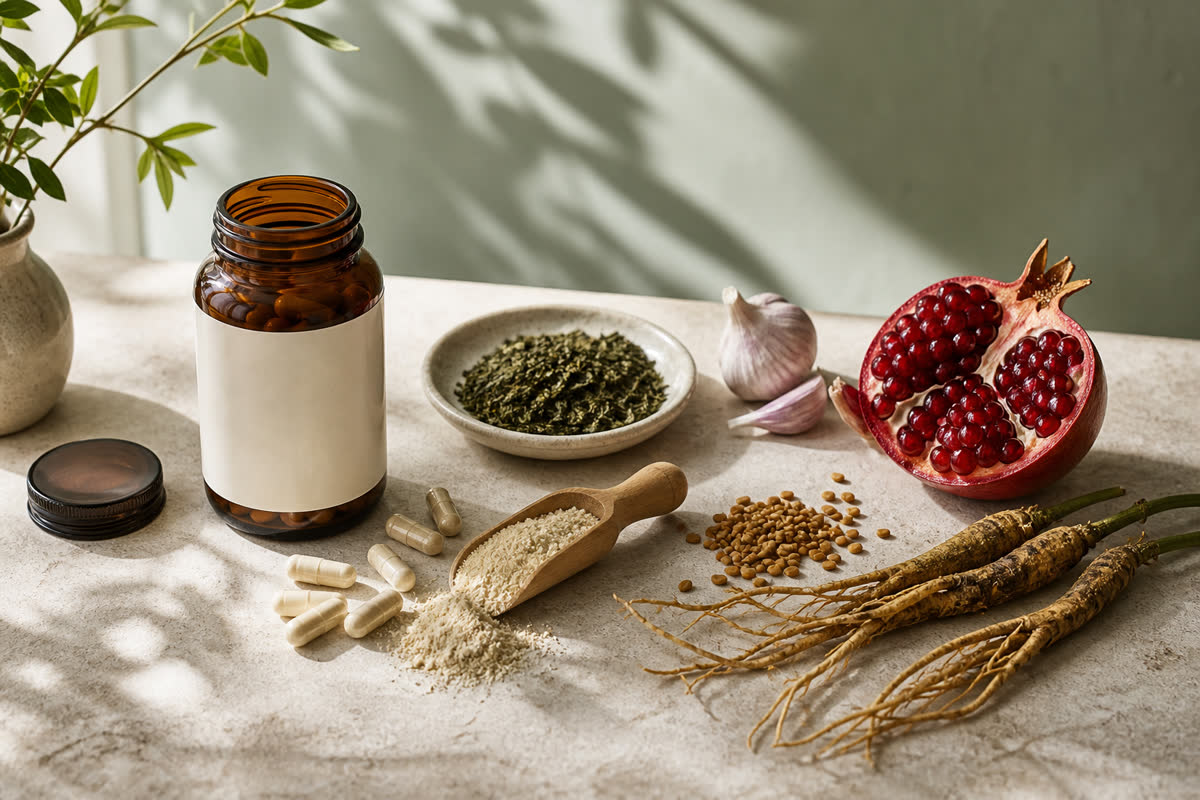
Most of the supplement aisle is sold on a hormone story. A typical “male vitality” formula stacks D-aspartic acid, fenugreek, ashwagandha, ginseng, green-tea catechins, pomegranate, garlic, zinc, vitamin D, and a couple of B vitamins, then implies that more free testosterone will buy muscle, fat loss, and extra years.
Longevity research asks a colder question. Do people who take this stuff live longer, stay healthier, or merely have a more expensive urine? The large trials we already have, including VITAL and a 2024 NIH cohort of 390,124 adults, are not kind to the idea that a capsule stack is a life-extension protocol.
That does not make every pill useless. A few nutrients have a real job when intake is low. A few botanicals have modest, specific effects. Almost none of them reverse ageing, and several of the testosterone claims collapse once you look at trained, well-fed men rather than marketing copy.
How to score a supplement
Three different questions get mixed together on labels:
- Does it correct a deficiency? Vitamin D, zinc, and B12 can, in the right person. That is a medical use, not an anti-ageing hack.
- Does it change a useful marker? Blood pressure, sleep, strength in a training study. Markers are not extra years.
- Does it change how long people live? Almost nothing on this shelf has that evidence in humans. The eight lifestyle factors that tracked with decades of extra life in veterans did not include a single supplement.
If a product cannot tell you which of those three it is claiming, treat the claim as advertising.
The short list that can earn a place
Before the twelve-ingredient formula, the boring candidates.
Vitamin D, if you are actually low
Vitamin D is required for calcium absorption and bone mineralisation. The US RDA is 15 mcg (600 IU) a day for most adults and 20 mcg (800 IU) from age 71, assuming little sun. Deficiency can cause osteomalacia in adults. That is the solid case, and it is enough.
It is not “the best vitamin to reverse progressive ageing.” In VITAL, 25,871 adults took 50 mcg (2,000 IU) of vitamin D3 or placebo for a median 5.3 years. Vitamin D did not reduce invasive cancer or major cardiovascular events. All-cause mortality was essentially unchanged (hazard ratio 0.99). A later VITAL analysis also found no fewer fractures in this generally vitamin-D-sufficient group.
There is a secondary signal worth not overselling: cancer deaths looked a little lower, especially after excluding the first year or two of follow-up. That is a hypothesis, not a reason to mega-dose. The NIH fact sheet still treats bone health as the established use. The Endocrine Society now recommends routine supplementation for children, pregnant people, adults with prediabetes, and adults 75 and older, not for healthy adults aged 19 to 74.
Practical version: if you rarely see sun, have dark skin at a high latitude, eat little fortified food, or a clinician has documented a low 25(OH)D level, a standard dose is reasonable. Treating a normal level with a “testosterone support” capsule is not the same intervention.
Zinc, if intake is low, not as a manhood pill
Zinc is a cofactor for hundreds of enzymes. It matters for immune function, wound healing, and protein synthesis. The RDA is 11 mg for men and 8 mg for women. Most people in high-income countries get enough from food: oysters, meat, poultry, dairy, beans, nuts.
The testosterone story is a deficiency story. Severe zinc depletion can impair the reproductive axis; restoring zinc in deficient men can restore function. That is not evidence that extra zinc raises testosterone in someone already eating steak. A 2023 systematic review of “testosterone boosters” did not find zinc or zinc/magnesium stacks to be reliable T-raisers in healthy men.
High doses are not free. Intakes of 50 mg or more for weeks can block copper absorption, blunt immunity, and lower HDL. The adult upper limit is 40 mg from food plus supplements.
Creatine, for muscle you intend to keep
Creatine is the rare powder with a training literature behind it. It is not a longevity drug. It is a small amplifier of the work that preserves strength and power, which is the healthspan case. Details, doses, and caveats live in the creatine review.
Omega-3s, preferably as fish
People who eat fatty fish tend to do better in observational work. That is why salmon sits on the longevity plate. Capsules are a weaker substitute. In VITAL, 1 g a day of marine omega-3s did not cut the primary composite of heart attack, stroke, or cardiovascular death. A secondary signal for fewer heart attacks appeared, especially in people who ate little fish, and should be read as exploratory.
If you already eat fish a couple of times a week, a bottle is optional. If you never eat fish, food is still the first move; a standard fish-oil capsule is a backup, not a cardiology clinic.
A typical vitality stack, scored honestly
These are the ingredients that show up again and again in male “T-booster” formulas. None of them has human lifespan data. Some have a narrower job.
D-aspartic acid
Early work in infertile men made it look like an LH and testosterone lever. In resistance-trained men, 3 g a day did nothing, and 6 g a day lowered total and free testosterone in a randomised trial. A later training study found no effect on hormones, strength, or body composition.
Panax ginseng
NCCIH: small, short trials; possible modest help for fatigue and some sexual-function scores; no reliable athletic-performance benefit; not enough to call it an ageing treatment. Insomnia is the common side effect. It can lower blood sugar and interact with medicines.
KSM-66 ashwagandha
The NIH summary is fair: extracts may reduce perceived stress and cortisol, and a 2021 meta-analysis found a small sleep benefit, clearer at about 600 mg/day for at least eight weeks. A 2015 training RCT reported extra strength and a testosterone bump in novice lifters. That is not a longevity trial, and rare liver injuries are now documented.
Fenugreek
A meta-analysis of four trials found a rise in total testosterone. The literature is small, often industry-adjacent, and does not show extra years of life. Fenugreek can lower blood glucose, which matters if you take diabetes medication.
Green tea catechins
Brewed tea is a reasonable habit. Concentrated extracts are a different product: modest effects on LDL and weight, plus uncommon but real liver injury, especially in capsule form. “Blocks DHT” is a hair-loss marketing line, not a healthspan mechanism you should buy.
Pomegranate extract
Whole pomegranate brings polyphenols and fibre. Extracts are sold on nitric oxide and immunity. Human data are small and mixed. A fruit you chew beats a 40% ellagic-acid capsule for any longevity pattern we actually have.
Vitamins B6 and B5
B6 is essential; deficiency is uncommon on a mixed diet. High-dose B6 can cause sensory neuropathy. The adult upper limit is 100 mg, and some regulators have moved lower. B5 (pantothenic acid) deficiency is vanishingly rare. It is not a fat-burning or testosterone vitamin.
Garlic extract
Meta-analyses find a few millimetres of mercury off systolic pressure, more clearly in people who already have hypertension, plus a small LDL effect in some reviews. Cooking garlic is the low-risk version. Supplements can add breath, gut upset, and bleeding-risk questions around surgery.
Black pepper extract
Piperine is added to raise absorption of other compounds. It can also change how the liver handles medicines. It is not a longevity ingredient. It is a pharmacokinetic hitchhiker.
A 2023 systematic review in the International Journal of Impotence Research looked at 27 advertised T-boosters. Most failed to raise total testosterone versus placebo. Ashwagandha was only “possibly effective” in healthy men. D-aspartic acid was not. Even when a herb nudges a hormone number, that is not evidence it extends healthspan. Muscle, sleep, and metabolic health are the outcomes that matter for ageing, and they are still earned mostly in the gym, the kitchen, and bed.
What the labels get wrong
“Reverse ageing.” No ingredient in this stack has been shown to reverse ageing in people. Vitamin D treats a deficiency disease of bone. That is already a good use. It does not need a fountain-of-youth caption.
“Blocks DHT / blocks estradiol.” Free testosterone, DHT, and estradiol are not cartoon villains. DHT is involved in prostate and hair biology; estradiol is required for male bone and fat distribution. Trying to “keep all the T and none of the conversion” is not a longevity strategy, and green-tea or zinc capsules are not precision endocrine tools.
“Antioxidants fight toxins.” Plants contain polyphenols. Eating plants is associated with lower mortality. Isolating one extract, standardising it to 70% catechins or 40% ellagic acid, and calling that detox is a category error. The food-group data are about patterns, not proprietary blends.
Proprietary blends. If a label will not tell you the milligrams of each ingredient, you cannot compare it with a trial dose. KSM-66 studies used about 600 mg/day of root extract. A “blend” that buries 50 mg of ashwagandha next to 10 other powders is not the study product.
- Green tea extracts have a documented, uncommon liver-injury signal. Brewed tea does not carry the same warning.
- Ashwagandha is usually well tolerated for a few months. Case series now link it to cholestatic liver injury, and it can affect thyroid hormones. Denmark has restricted it; France has warned specific groups off it. Avoid it if you have liver disease, are pregnant, or have a hormone-sensitive prostate cancer.
- Zinc above the 40 mg upper limit can create a copper problem that looks like “more manly” on a label and like neuropathy in a clinic.
- Piperine, ginseng, fenugreek, and garlic can interact with drugs: blood sugar, blood pressure, anticoagulants, immunosuppressants. A stack is several interactions at once.
What to do instead of buying the whole shelf
The useful order of operations is the unglamorous one:
- Fix the behaviours that already have mortality data. Not smoking, moving, sleeping, eating plants and fish, keeping alcohol modest, staying connected. That is the Million Veteran Program list, not a capsule list.
- Eat the foods that already carry these compounds. Fatty fish and daylight for vitamin D, meat or legumes and nuts for zinc, tea as a drink, garlic in food, pomegranate as fruit, protein and training for muscle.
- Correct a documented gap. Vitamin D if 25(OH)D is low. B12 if you are older or vegan. Zinc if intake or absorption is actually poor. A basic multivitamin can cover small dietary holes; it has not been shown to cut deaths.
- Add one boring, single-ingredient product if it has a job you care about. Creatine monohydrate for training. Ashwagandha for a time-limited stress or sleep experiment, with the liver caveat. Not a twelve-herb T formula.
If you want a number: a reasonable vitamin D dose for an adult who needs a supplement is usually in the 600–2,000 IU range, not a megadose. Zinc, if used, should stay near the RDA unless a clinician is treating deficiency. Creatine is 3–5 g of monohydrate. Everything else on the vitality label is optional, and most of it is optional in the strong sense: you can skip it.
The longevity version of supplementation is not a stack that “releases free testosterone for many great functions.” It is this: do not be deficient, do not mega-dose, and do not let a bottle substitute for the habits that actually move the survival curves.
Sources
- NIH Office of Dietary Supplements: Vitamin D, health professional
- NIH Office of Dietary Supplements: Zinc, health professional
- NIH Office of Dietary Supplements: Ashwagandha
- NIH Office of Dietary Supplements: Vitamin B6
- NIH Office of Dietary Supplements: Pantothenic acid (vitamin B5)
- NCCIH: Asian ginseng
- NCCIH: Green tea
- Manson et al.: VITAL, vitamin D, cancer and cardiovascular disease (NEJM, 2019)
- Manson et al.: VITAL, marine n-3 fatty acids (NEJM, 2019)
- LeBoff et al.: VITAL ancillary, vitamin D and fractures (NEJM, 2022)
- Loftfield et al.: Multivitamin use and mortality, 390,124 adults (JAMA Network Open, 2024)
- Morgado et al.: Do “testosterone boosters” raise total testosterone? (Int J Impot Res, 2024)
- Melville, Siegler, Marshall: 3 g and 6 g D-aspartic acid in trained men (JISSN, 2015)
- Willoughby and Leutholtz: D-aspartic acid and resistance training (Nutr Res, 2013)
- Wankhede et al.: Ashwagandha, strength and testosterone (JISSN, 2015)
- Cheah et al.: Ashwagandha and sleep, meta-analysis (PLoS One, 2021)
- Mansoori et al.: Fenugreek extract and testosterone, meta-analysis (Phytother Res, 2020)
- Ried: Garlic, blood pressure and lipids, updated meta-analysis (J Nutr, 2016)
- LiverTox: Ashwagandha
- LiverTox: Green tea
- FDA: Questions and answers on dietary supplements